The Method
Each installation
begins before opening
the first scroll.
Luxury wallpaper isn’t simply installed—it’s orchestrated. A roll of hand-painted silk from de Gournay can cost thousands of euros. When a material of this value arrives on-site, there is no room for improvisation, approximation, or last-minute corrections.
First and foremost, you look. You touch the walls, measure the surfaces, assess the condition of the plaster, and identify any irregularities. A wall that looks perfect to the naked eye may hide problems that only become apparent once the wallpaper is removed: residual moisture, layers of paint incompatible with the adhesive, or unevenness that would distort the pattern.
The site inspection is not a formality. It is the moment when you decide whether and how to proceed. In some cases, it leads to recommending surface preparation before installation—a step that many skip to save time and that ends up costing ten times more in repairs.
WHAT'S INCLUDED
Condition of the plaster · Presence of moisture · Surface flatness · Actual heights · Architectural obstacles · Lighting and temperature conditions
Not all materials are installed in the same way. Eco-friendly paper behaves differently from vinyl non-woven fabric. Vinyl on paper expands when it comes into contact with adhesive and requires double gluing. Silk paper does not tolerate excess moisture. Materials printed on a single sheet do not allow for positioning errors because there is no second identical panel.
Before beginning installation, the specific material for the project is studied: the manufacturer’s instructions, technical specifications, and known critical issues. If the material is new or unusual, it is tested on a sample surface before proceeding with the final work.
WHAT'S INCLUDED
Eco-friendly paper · Vinyl non-woven fabric · Vinyl on paper · Natural silk · Rice paper · Non-woven fabric · Digital prints on single-piece fabric · Fire-retardant contract materials
Surface preparation accounts for 40% of the quality of an installation. A wall that hasn’t been properly prepared transfers every imperfection to the wallpaper—and on a luxury material, every imperfection is visible.
Preparation includes filling in irregularities, sanding, applying a primer specific to the type of material, and, when necessary, installing a reinforcing fabric on particularly problematic walls. Installation proceeds only when the surface is in optimal condition.
On many job sites, this phase is delegated to others or skipped entirely. We handle it directly, because it is the only way to guarantee the final result.
WHAT'S INCLUDED
Filling · Sanding · Material-specific primer · Reinforcing fabric · Final flatness check
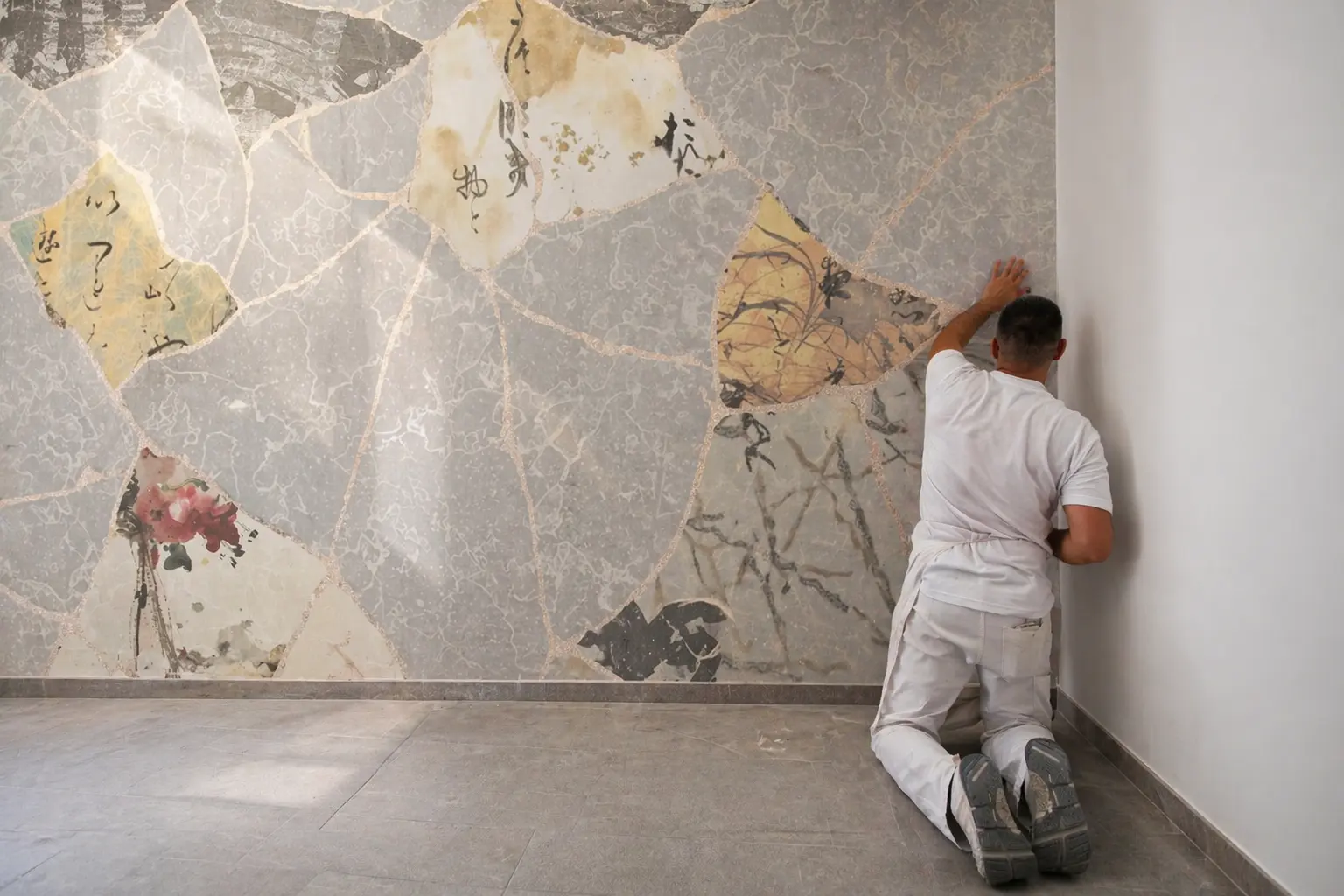
Installation is the visible part of the job—but at this stage, if the previous steps have been carried out correctly, it is also the most controlled part. Variables have been minimized. The surfaces are ready. The material has been carefully selected. The installation plan is set.
Each panel is positioned in a precise order, with constant attention to pattern alignment, verticality, uniform pressure, and the elimination of air bubbles and open seams. On particularly delicate materials—such as silk or rice paper—we work with specialized tools that leave no marks on the surface.
Speed is never the goal. The goal is the result. Deadlines are met because the work is planned—not because we rush.
WHAT'S INCLUDED
Precise pattern alignment · Seamless joints · Controlled vertical alignment · Material-specific tools · Double gluing when necessary
Before a job is considered complete, every surface is inspected under raking light—the harshest lighting condition that reveals any imperfections invisible under normal light. If something isn’t perfect, we correct it before delivery, not after.
Delivery also includes instructions for routine maintenance of the installed material: how to clean it, what to avoid, and how to handle any minor damage that may occur over time. An informed customer is a satisfied customer, even years later.
WHAT'S INCLUDED
Inspection under raking light · Pre-delivery adjustments · Equipment maintenance instructions · Warranty on work performed
The Importance of the Method
Why Choose an Installer with a Method
There are hundreds of wallpaper hangers in Italy. Most do a good job with standard materials under normal conditions. The problem arises when the material is expensive, the space is complex, or the project leaves no room for error.
Luxury wallpaper damaged during installation cannot be repaired—it must be replaced. And replacing a de Gournay or Fromental panel, when available, requires weeks of waiting and costs that can far exceed the cost of the original installation. In many cases, the panel is unavailable: it was produced in a limited series, or it is a one-of-a-kind hand-painted piece.
This is why luxury brands—Glamora, Officinarkitettura, Inkiostro Bianco—do not recommend just any installer. They recommend installers whose methods they know, whom they have seen at work, and whom they trust. Flavio Favali is one of them. He is also the installer these brands call upon to train other installers—because teaching a method requires having one.
Do you have a project that requires this level of attention?
Every installation begins
with a conversation.
Describe your project—the materials, the space, the timeline—and you’ll receive a precise technical assessment, not a generic quote.